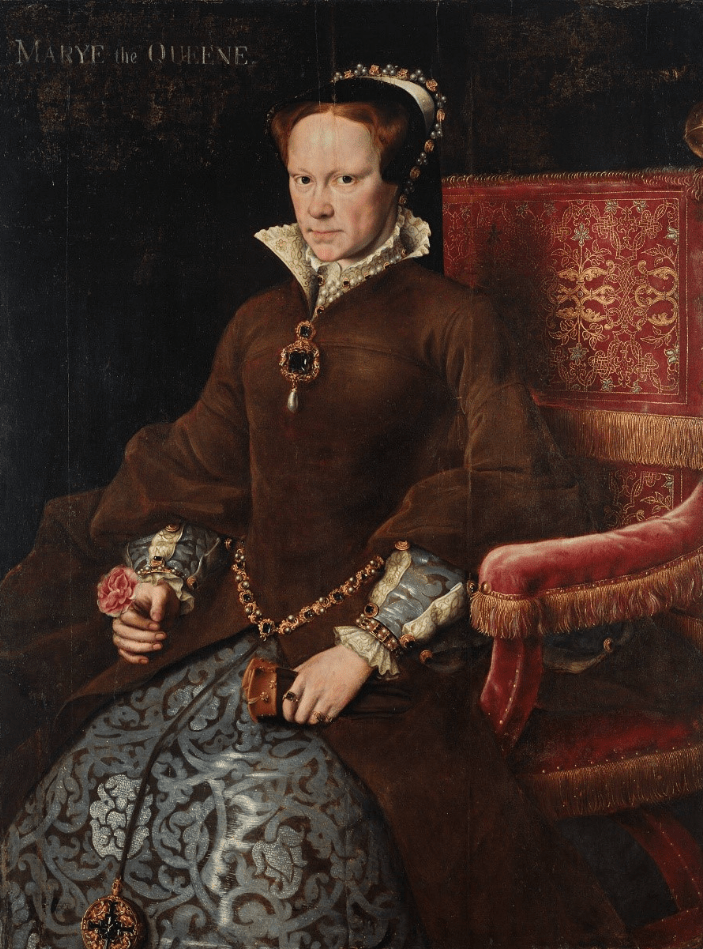
Bloody Mary, Quite Contrary: Reassessing the Reign of Mary I
Katrina Anderson and Dr. Kyle Robinson
History popularly paints Queen Mary I as a poor ruler, almost tyrannical, heavy-handed, and murderous. The origin of her famous moniker of “Bloody Mary”. However, this view is unfair. Instead, she must be examined in her context as a Catholic Queen pragmatically ruling a Protestantized England thinking through the best methods to restore the old faith. Though often misunderstood and characterized by Protestant historiography as “Bloody Mary,” this episode argues that Mary Tudor was in fact a responsible and sober-minded Catholic monarch.
How can we study belief? What are the longer term implications of religious change in society? These connected questions form the core of our course and our investigation of Early Modern Europe (c. 1450-1789). Indeed, the meaning of belief was the central issue of contention in Europe from the dawn of the Renaissance until the twilight of the eighteenth century and its Revolutions.
The shattering of the Christian consensus and the rise of the empirical frame was a pathway cleared with the twin swords of Humanism’s cry of ad fontes and Luther’s injunction of sola fide. The route uncovered was a journey to the “Modern” in all its beauty and ugliness. Yet, stones lay upon this trail, rocky reminders whose pain and obstacle convey the irony that Europe’s greatest religious revolution resulted in the ultimate secularization of the continent and of the West in general. Still, secularization, caught as it is in a dialectic with Christianity, is a form of belief, and belief remains central.
The effort to experience, define, and understand both acceptable and unacceptable beliefs will be our compass to map Europe’s Early Modern world, the world of unfolding Reformations. This course will consist of primary and secondary readings, lecture, classroom discussion, as well as multiple student writing assignments culminating in a final research based student podcast.
View more posts